Monday, February 28, 2022

Predator Glamour

Predator Glamour


When I was six, I went to a church run school, where I was introduced to bible stories for the first time. There was the creation story, where Adam and Eve eat some fruit, which somehow, was bad. Then, when they have kids, there is a competition for God’s favor: one son eats animals, the other one eats a plant based diet. I still remember being shocked that God liked the meat eater better! That was the beginning of my suspicion that something was wrong here.


This strange headspace has continued to this day. Everywhere on this violent planet, cultures admire the predators. Hawks, eagles, lions, tigers, bears, sharks. It is a plus if they are poisonous, like cobras, scorpions, or sting rays. We love to name cars, sports teams, and weapons systems after the predators. What is the attraction, the source of this admiration? A predator is a murderer and a thief, violently stealing life force from its prey.  

What is to admire in that? Who can blame animal predators that act on instinct, shaped by long evolution, fitting into their place in nature. Seems like the vultures deserve more admiration, then, for cleaning up the rotting bodies dropped by animals who have moved on and no longer need them?
Why is it that we seem to think if we are not the top killer, we must then be the prey, the victim, the loser? Why this duality? Why do we have to be the biggest baddest scariest predator?
The whole predator-prey duality is the same coin with two sides. We need to rise above the binary. Violence or hate can’t be defeated with the same; only love can encompass and then transcend the binary. As long as we are enthralled with the predator-prey duality, we will not be empowered to garden this beautiful world as the true leaders we fancy ourselves to be. 
We will just be the top predator, living in the self created chains of our fear, destined to be displaced in that role by the next predators to come along.
I have difficulty finding the right words to describe what we are on this planet, if not the apex predator. The masters of the planet? The property managers? The owners? Every description is stuck in this binary of predator and prey, dripping with rankist, dominator based, hierarchical language. 
We are in charge of running the planet? Ruining the planet, maybe. 


We aren’t even in charge of ourselves. We may say we want to have mastery over ourselves, but a lot of damage is being done right now by efforts to have control, not of ourselves, but to exert control over other people. And all of the creatures, and the environment, and even the future of all life on earth!

Maybe we are the keepers of the garden?
Why not be instead, the comprehensive cooperative compassionate gardener? Who is more wise, indeed, more truly powerful? Every positive loving thought, or love motivated action is ten times more creative and powerful than a negative violent one. 
Who is truly worthy of our admiration, the mother who spends years pouring gentle love and attention into the next generation, or the fighter who can kill some hapless animal or person in a single swipe? The gardener who skillfully and patiently works with nature to bring nourishment to many, or the hunter who pounces on prey like a lion?


 We are needed to take responsibility for the whole planet now, with loving care. There is no place for the nonsense of the glamorizing of predatory behavior anymore. Somehow, we must get out of this binary trap. 
The only way to rise above the dominater-victim duality is to stop being the predator and start being the gardener. To give a care, and take care for the whole thing. To think comprehensively, to take whole systems into account when making decisions.  To move in cooperation with the beings and other life forms who together make up ecosystems. To be aware of the trajectory of our actions on the axis of time lines that reach into the future, that have evolved to carry forth the wisdom experience of the past. To truly be in charge of our resources, instead of charging around destroying stuff.


“You can’t take sides when you know the Earth is round” -P. Sun

Friday, January 28, 2022

Travel Threads

Travel Diaries


We are traveling light. 
My fiber yarn of choice for traveling is my embroidery floss bag. 
I gather some twigs fallen from the trees as we wander. 
I like the kind with little knobs on both ends. 
One twig is a perfect equal cross, so it is just right for a God’s eye.
Ojo de Dios.

We are visiting my favorite mountain, and I gather the colors of the mountain and its setting of sky and trees from my yarn bag.
 The center, the focalizing point of the ojo is the mountain, of course. 
It is glistening, snow covered, a crystal outstanding 14,000 feet in the deep blue sky, with the forest greens all around.


First I weave mountain, then sky, then forest. 
Soon I will add tassels.


“Some people have had visions during sacred ceremonies in which they received guidance from Infinite Creator who appeared before them in many shapes, though the eyes of the God were so intense and overwhelming that many could only see the eye of the God. To show others the vision they had, they made the God's eye - woven on sticks with handspun yarn, colored with various types of berries, flowers, and other materials to capture the essence of their vision.” Wikipedia 


Monday, December 27, 2021

I Cherish the Sheep

I Cherish the Sheep


They say every spinner eventually gets curious about other fibers than wool. 

With me, it turns out the other way around.

First, I try various other animal and plant fibers:

The neighbor’s mountaineering pack llama fleece. 

My friend’s prize winning alpaca fleece. 

The guard llama, Blue, down the road from us, who ferociously watches over his own little sheep flock.  

The family dog.

The pet angora rabbit.

The angora goats we had for a while, before they tried to eat all of the native flowers on the land, and we gave them to another sanctuary farm, run by a friends who had a lot of invasive plants to for them to gleefully chew through. 

The cashmere goats we babysat, for a friend, for a few months.

Exotic animals; yak, camel, etc.


Flax.

Organic natural colored cotton.

Rayon. 

Hemp.


Silk. Then raw silk, in which no harm is done to the silkworms. The abandoned cocoons are gathered, picked from the mulberry trees, actually. We even tried to grow some mulberry trees!


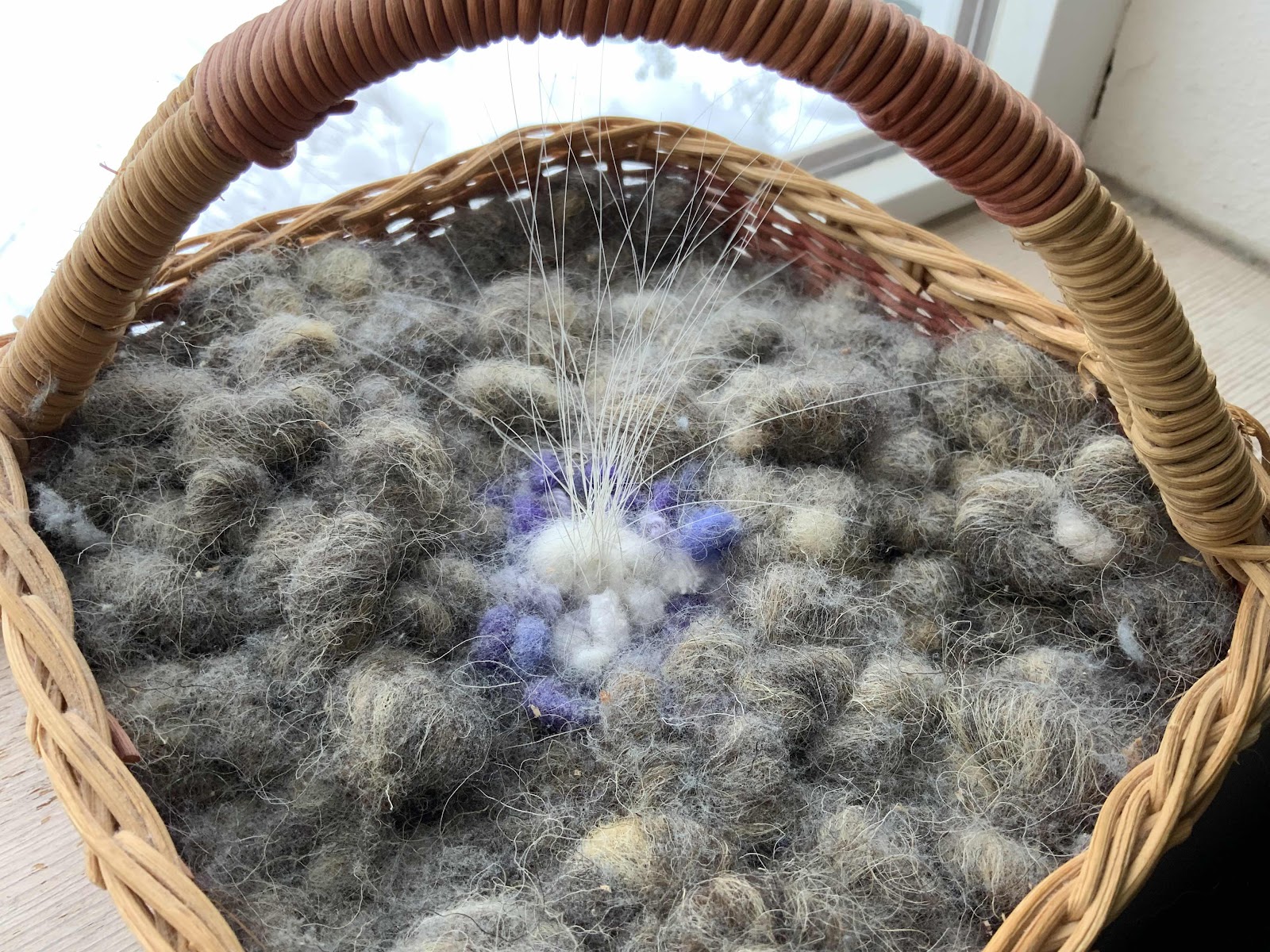
This is probably my weirdest fiber collection: It is all of the whiskers that my vegan cat (not his choice I admit) has shed onto the floor, which I have gathered, while vacuuming, over these last several years. 


It is only after trying almost every other fiber I could find, that I take a real interest in the most common natural fiber in the world, wool; rivaled only by silk and of course, cotton.


(Cotton is really the best fiber, when it is grown sustainably and with nontoxic and regenerative methods. The humble tee shirt, and blue jeans, are truly the apex of our civilization, in terms of fiber accomplishments. This is what the royalty of yesteryear would have worn, if they had had it. It is indeed what you see the corporate royalty of today wearing! 


(What Would Jesus Wear?):


But the bulk of these tee shirts and blue jeans are today still being made with pesticide laden, land degrading, water wasting, labor exploiting, fossil fuel polluting technologies. We soon really must do it right, because we can. All we have to do is want to. If we valued our beautiful textiles as our ancestors did, we would take care of them and not lay waste to the planet in their production.)


But I digress. Cotton is really hard to spin by hand, and it makes a dust I do not care to breathe when I try to do so. Silk is usually made by killing the silkworms to make the processing easier and make more profit. So silk has lost its shine for me.


So, slowly, I discover sheep wool. Of course, wool too, today is mostly from unethical and exploitative “big ag” operations, so called farms. There is even a breed of sheep they call a “Polypay”: it is bred to kill for meat AND to then use for wool! Overcrowded sheep are “dipped” in pesticides to keep them from being infested by parasitic insects. They roll across overused lands disrupting and mowing down native plant systems. As with silk, and cotton, we are doing a very bad job with the way we get wool, in general.


But I do find a few sources of what I consider ethical wool for handspinning. There are conservation and heritage breeds and programs. 

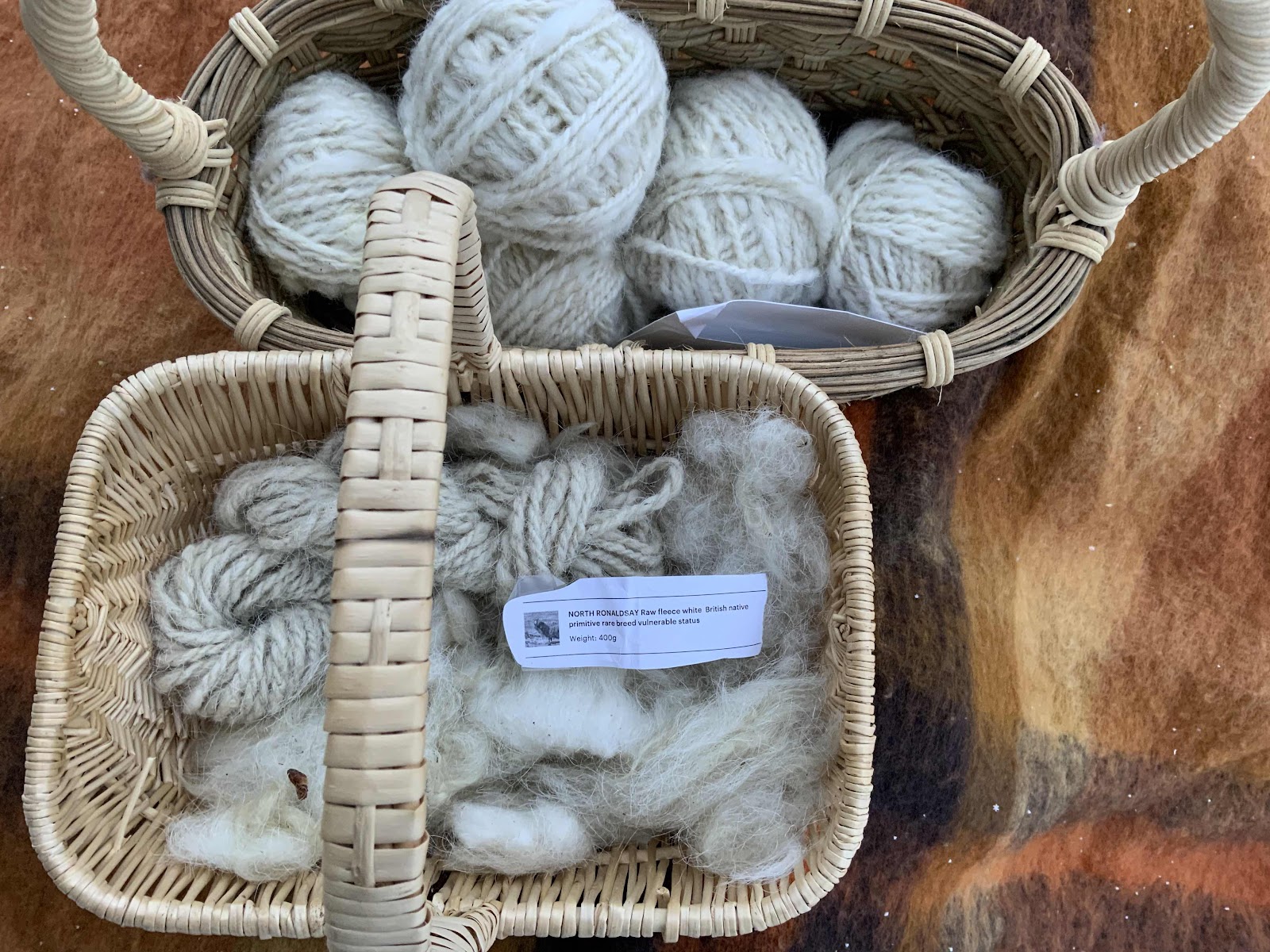
This yarn is spun from a threatened heritage breed that has learned to thrive on seaweed on a sparsely vegetated island north of the British isles:


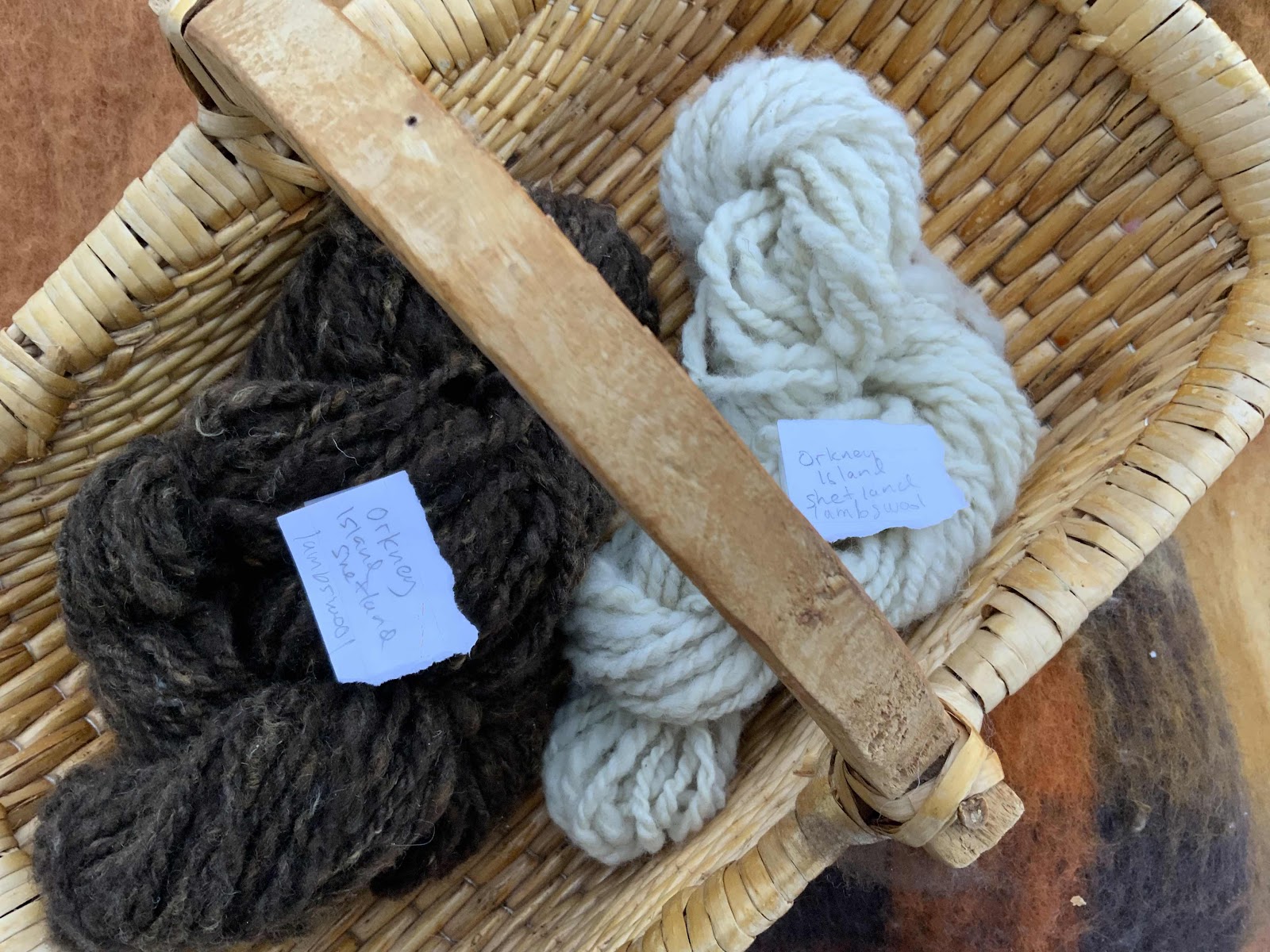
Here are some yarns from another heritage breed farm:


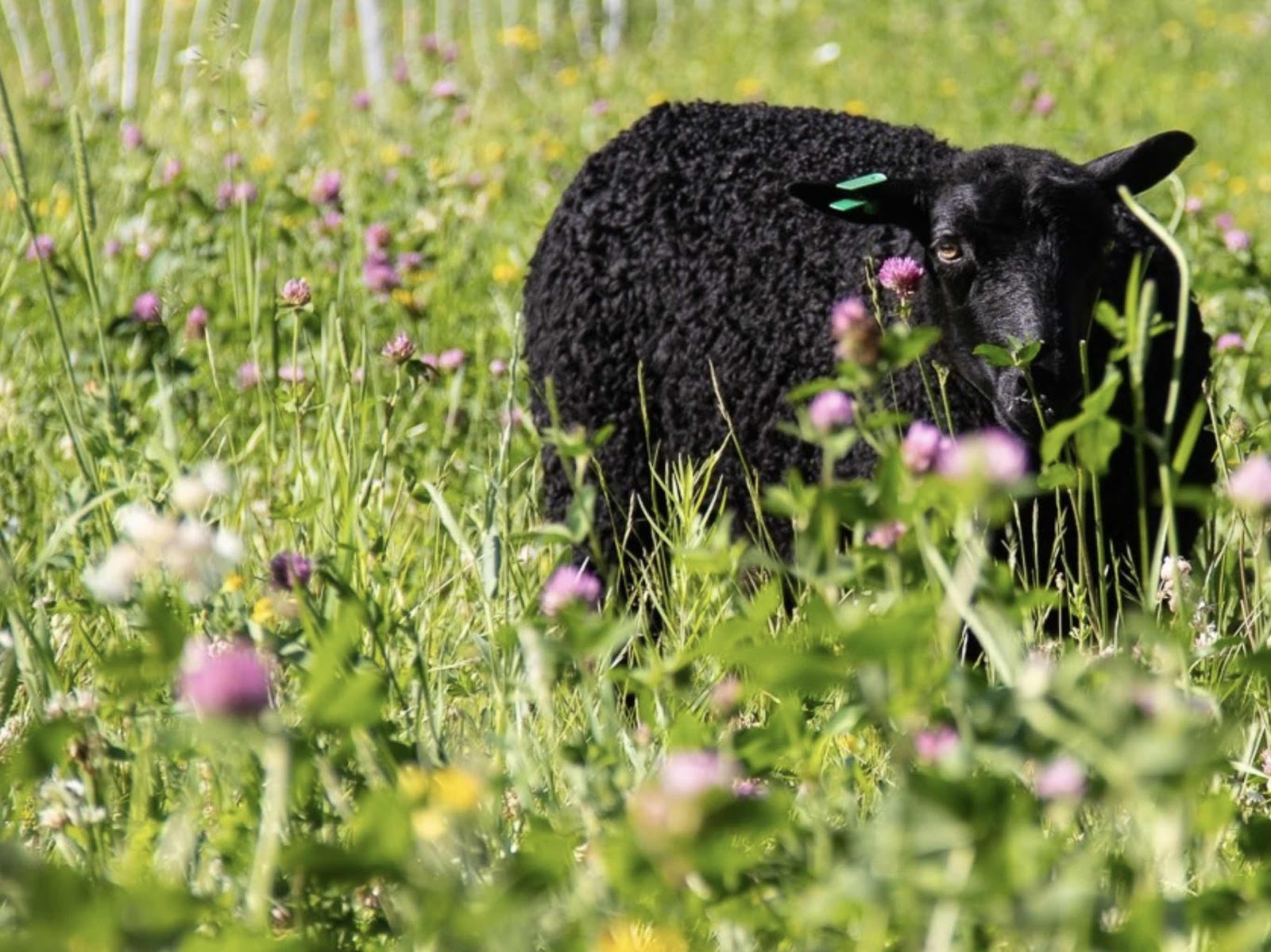
There are neighbors and farms that advertise the way they care for their sheep. (See quote at the end)


We could certainly do this on a wider scale. All we would have to do is, again, want to. It is like organically grown food, if people want to value it, and pay the true cost of the product instead of in effect stealing it from the commons in the form of a pollution debt passed on to the future, we can do it right. 


We do already know how. We could then truly take care of our textiles instead of throwing them away and having them hit the landfill within a year of purchase, as is the case today.


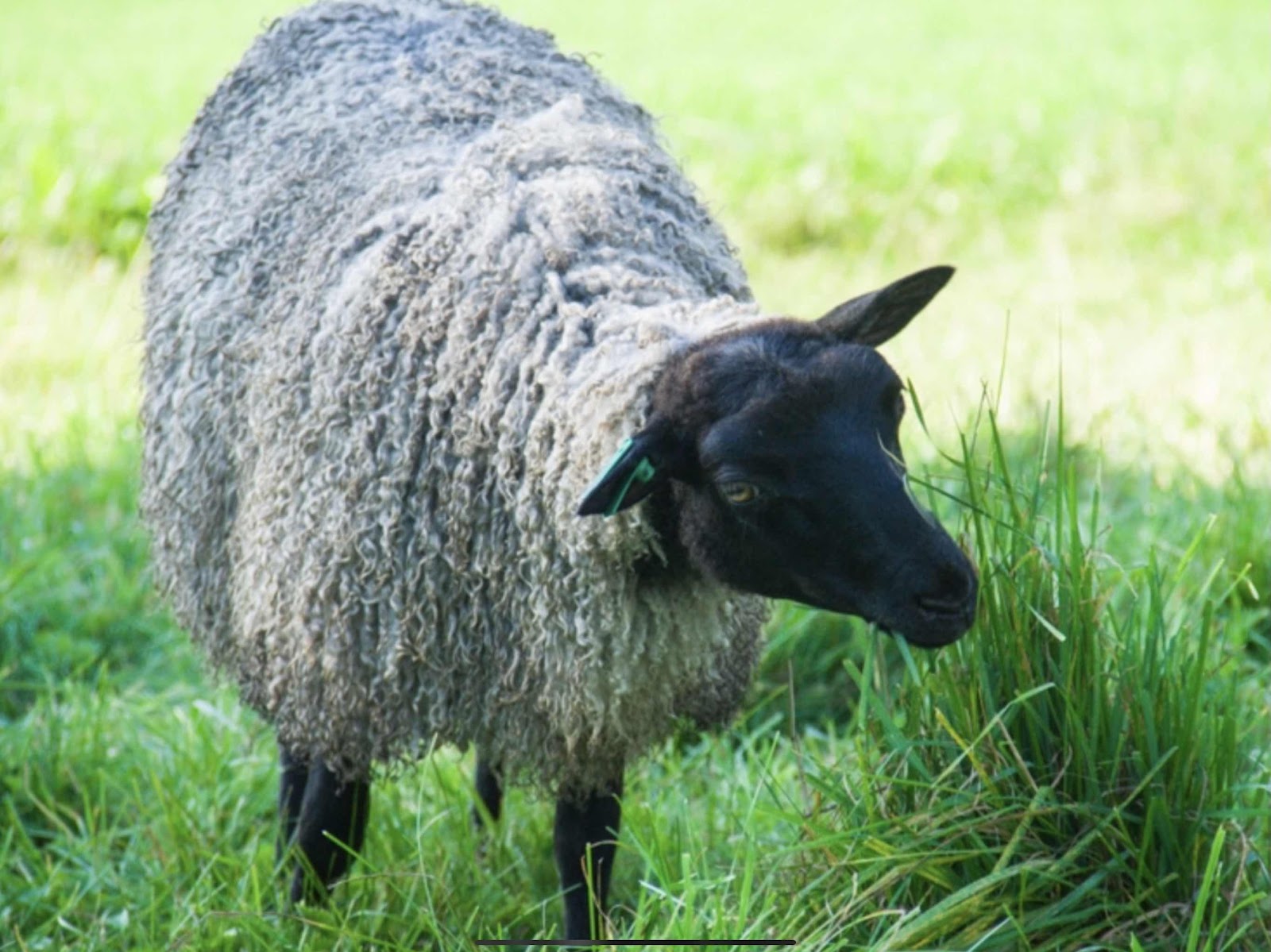
Done right, wool is second only to cotton as a wonderful and ideal fiber. I have fallen in love with sheep, and wool. Sheep wool is really fun to spin. It has a crimp and a bounce. It moisturizes your skin with its natural lanolin oils as you spin. Knitted, it makes a natural elastic. 


 Wool can keep us warm, and shed water. It can hold up to a fourth of its weight in water and still feel warm. It is strong and durable, coming in fiber sizes from tough as needed for a rug, to soft as you would want to use next to a baby’s skin. It comes in a wide range of naturally occurring colors, and takes dye well. The dye need not be a toxic type, and low water dye processes are being pioneered in places like Southern California.


Do not be dazzled by the fancy fibers made of plastic cheapness being cooked up in chemical factories today. Unlike the various fibers made from petroleum industry byproducts, natural fibers completely degrade. Plastic fiber derived cloth just breaks down into ever smaller pieces, and these microscopic bits are now found in air and water everywhere on our planet. Each bit attracts and binds preferentially with pesticides and other toxic chemicals. Once released, these poison bits are all but impossible to remove or reclaim, and are now building up in the food chain, and in the bodies of people and animals worldwide. 


So I buy organically grown clothing, and do my best to use ethical sourced natural fibers in my spinning, knitting, weaving, and art. And I try to take good care of my textiles. 


But individual actions are only a start. While providing personal demonstrations of sustainable alternative ways as object lessons, we also urgently need to convert all of our production systems to sustainable, “cradle to cradle”regenerative methods, by means of fair regulation, figuring in true cost, so harmful methods can no longer out-compete ethical methods.


“We mostly have sheep with a few alpacas, horses, peacocks, geese etc. Any animal here is here for life. We just all do the best we can. I decided years ago that I couldn't save all the animals but I could save my own so that is my focus.” - the farmer from whom I get most of my spinning wool


Thursday, December 23, 2021

Homeopathic Dye Experiment

Homeopathic Dye Experiment

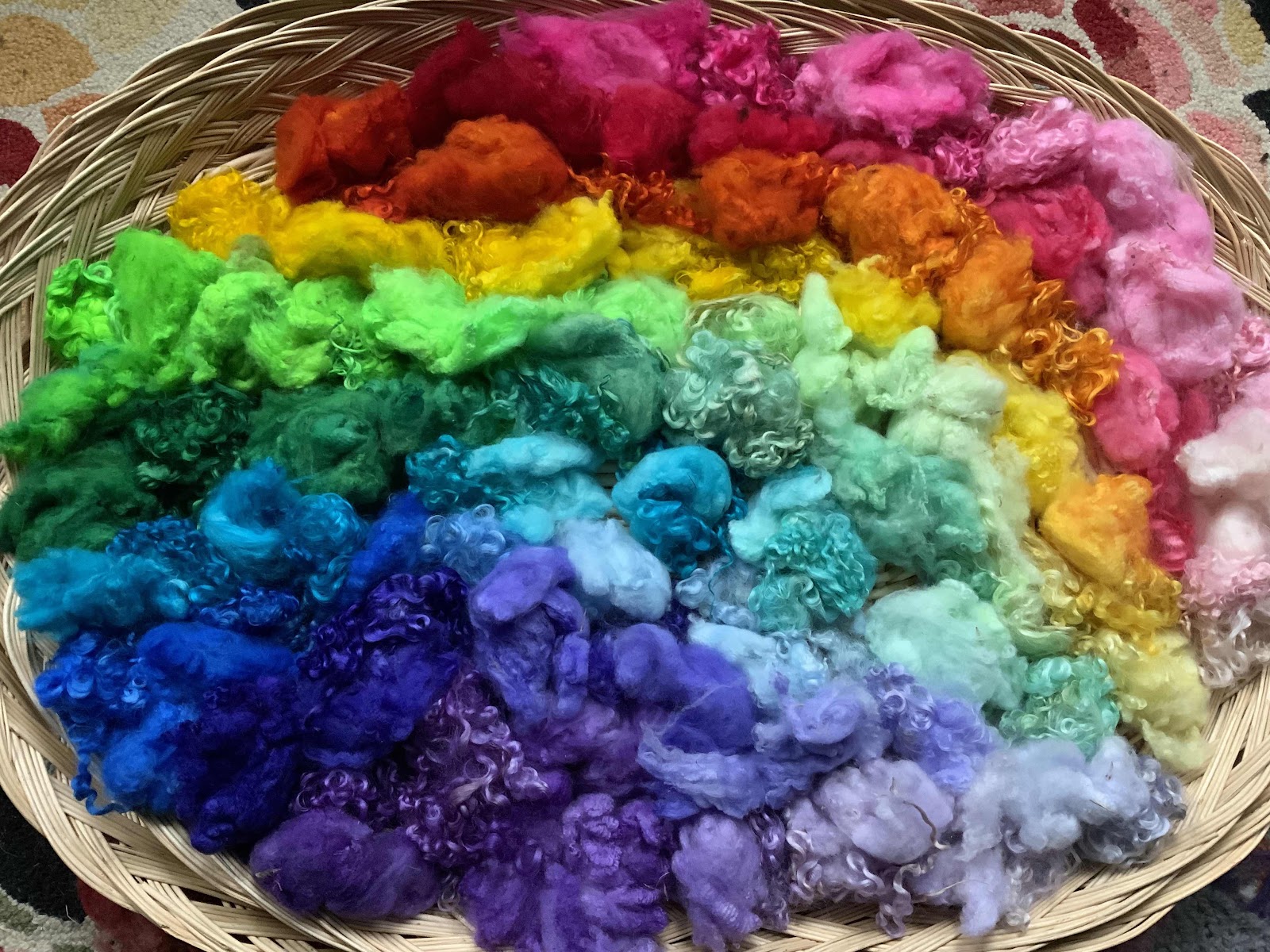
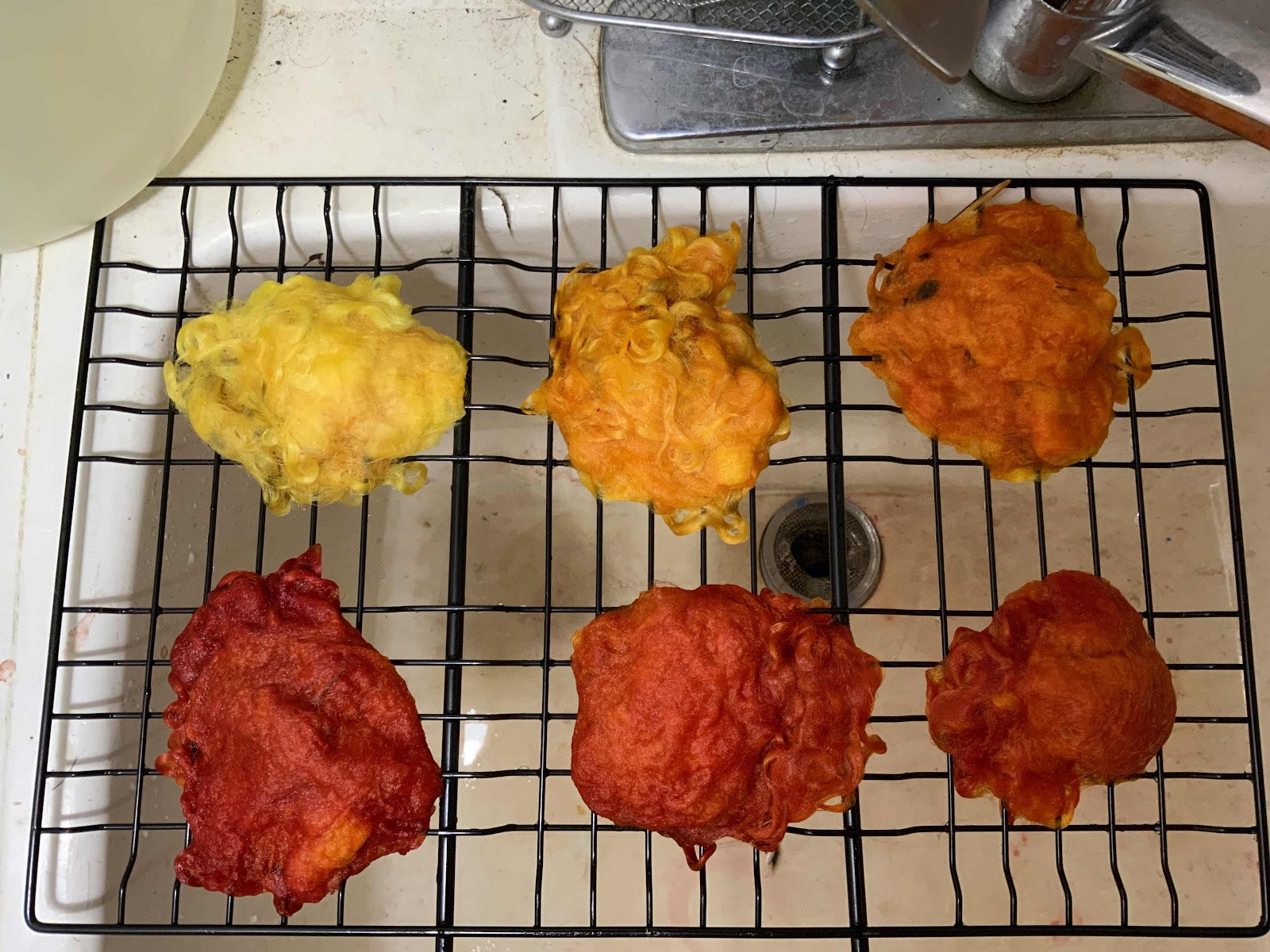
I am playing with colors again. I take a pinch of dye and dissolve it in a quarter cup of water. I pour half in a tiny little jar in the crockpot with a bit of fleece. 

I’m working with merino staples and a few stunning  teeswater twelve inch long curly locks I just got. 

With half of my dye left, I stir water in the mixing pitcher back to the same quarter cup level. Half of this goes into the next little jar. The third jar gets half as much as the previous one, and so on, until jar number six, which is so diluted that the water barely shows any color at all!

The orange dye at full strength turns the fleece almost red, but is quite yellow at the end, at the last dilution.

Turquoise is lovely and deep at the first jar, but a pale minty green at the end of the line.

Pink just keeps getting paler…

“All life is an experiment. The more experiments you make the better.” -Ralph Waldo Emerson


Wednesday, November 17, 2021

Leafing Through Fall Colors

"How beautiful the leaves grow old. How full of light and color are their last days.” 

-W Burroughs 


Once again I fall for autumn colors, as we leaf through the pages of poetry the trees drop all around us. Tales of heat, and sun, wind, and even rain. The leaves of the tree books crunch underfoot, scattered, free for all to read, no longer fastened in the branches and twigs where they were composed. Some fly gently down, and then fly again, as a passing breeze rustles them into songs, and lifts, sorts, and shuffles the stories.


“Autumn leaves don’t fall, they fly.” -Delia Owens


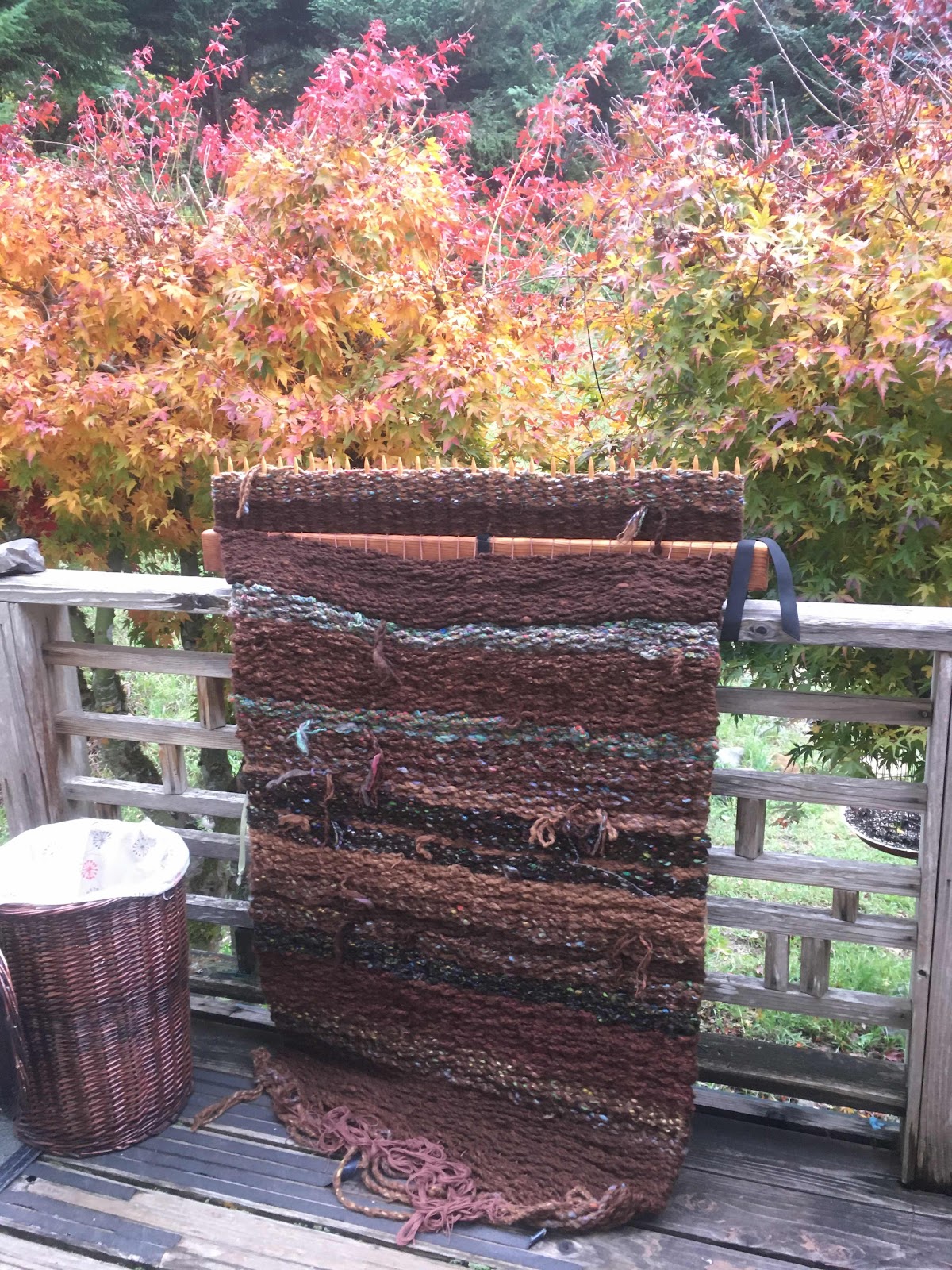
I am doing some stash busting fiber projects at the moment, with alpaca.


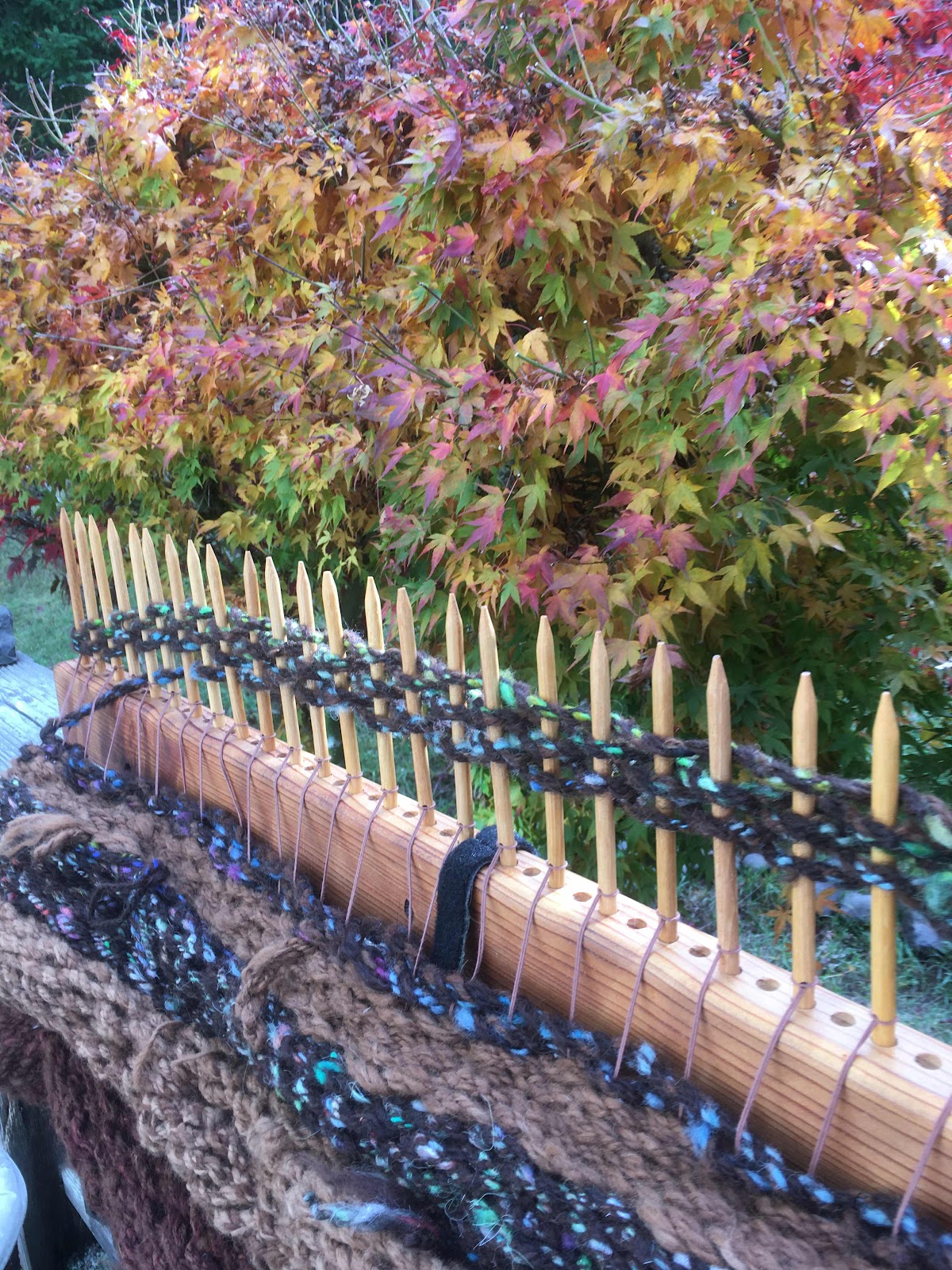
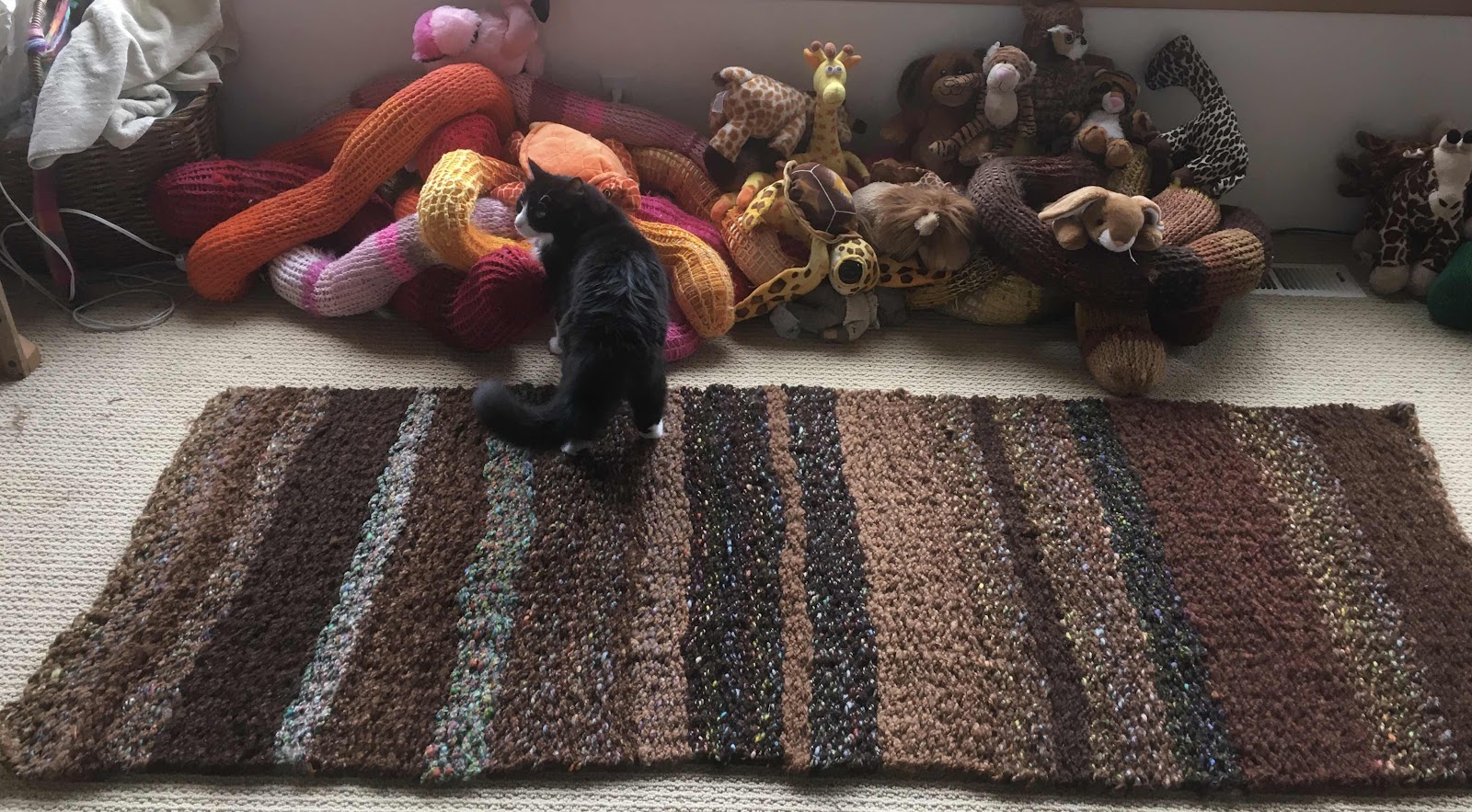
One is a rug that I make with all sorts of bits of leftover alpaca hand spun yarn, eight plying them together into mega yarn, and weaving the rug on a peg loom.


This year it is the dull brown oak leaves that call me. The ones with round edges, especially.


Many of the native oak groves here have been replaced with houses, farms, and roads, but a few can still be found here and there. This one is in a park that was once a ranch in the early days of this town, donated by a civic minded family, and now completely surrounded with city. 


It is the only spot I know of in my daily hikes where you can find a colony of acorn woodpeckers, sort of clownish looking birds, who nest in group apartments in the snags scattered about in this oak grove.


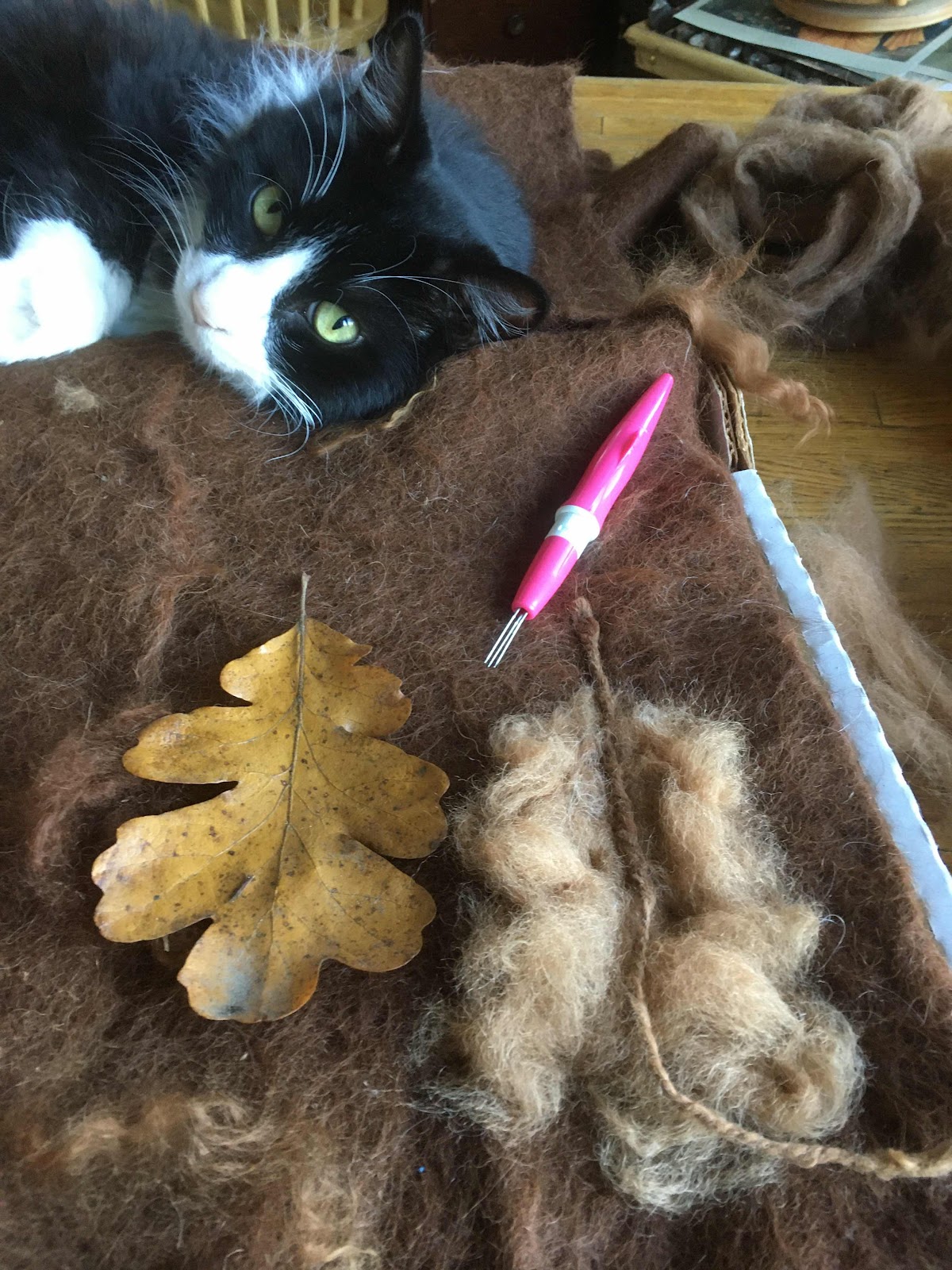
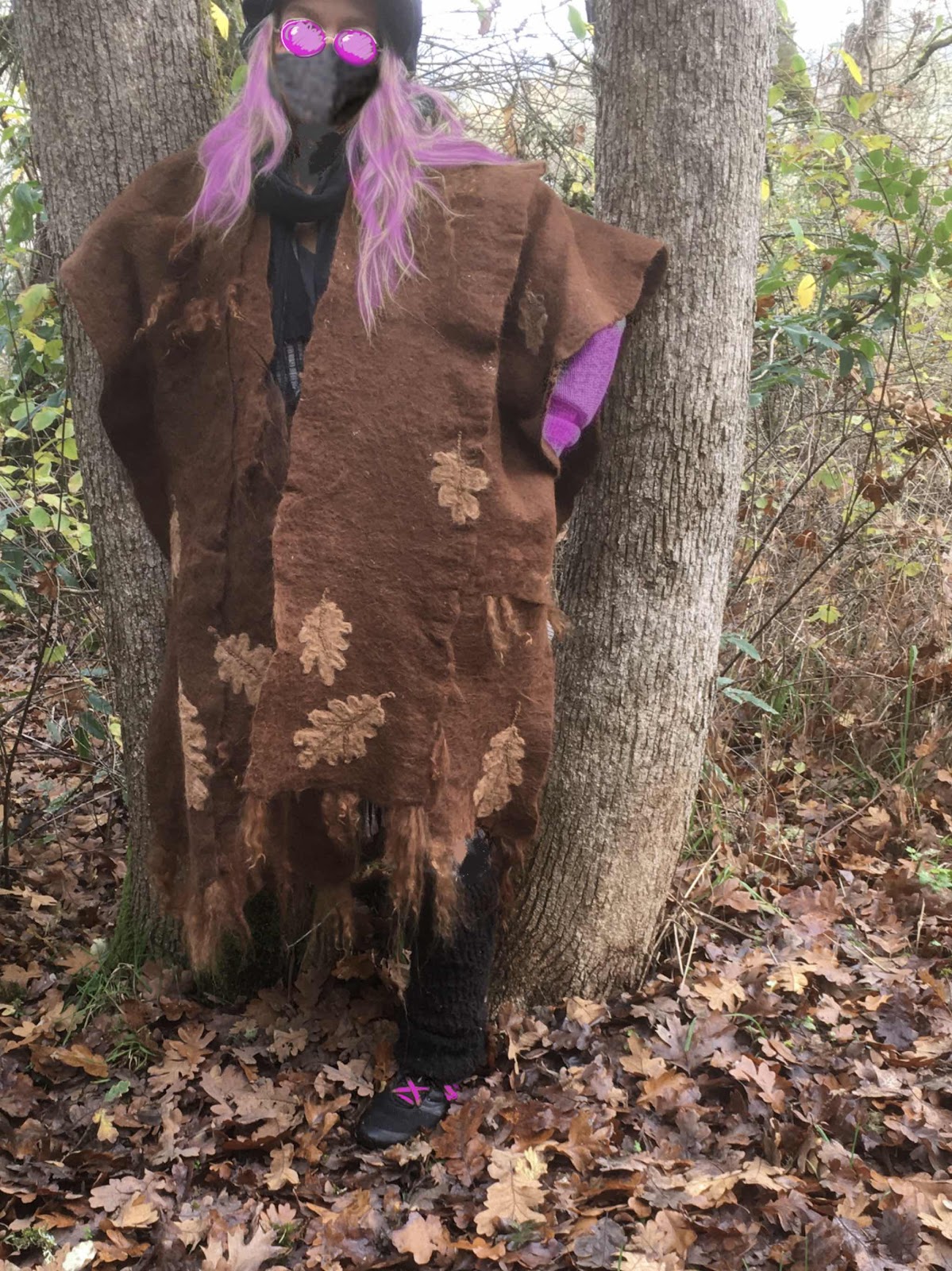
Next, I dig out a bag of naturally colored alpaca fleece that is such a warm brown that it is almost red. But the staple is very short, and difficult to spin. So I decide to felt. It is raining hard now, breaking the long drought of many months, at least for the moment. But it is not really cold, so I imagine a felt rain poncho. 


Such a large project can be made more easily if you felt it in smaller pieces, since felt severely shrinks the area of any surface you want to make. I felt each piece in two thin layers, resulting in six panels; sewing them all together at the end. Then I add some locks to the edges here and there, for decoration. 


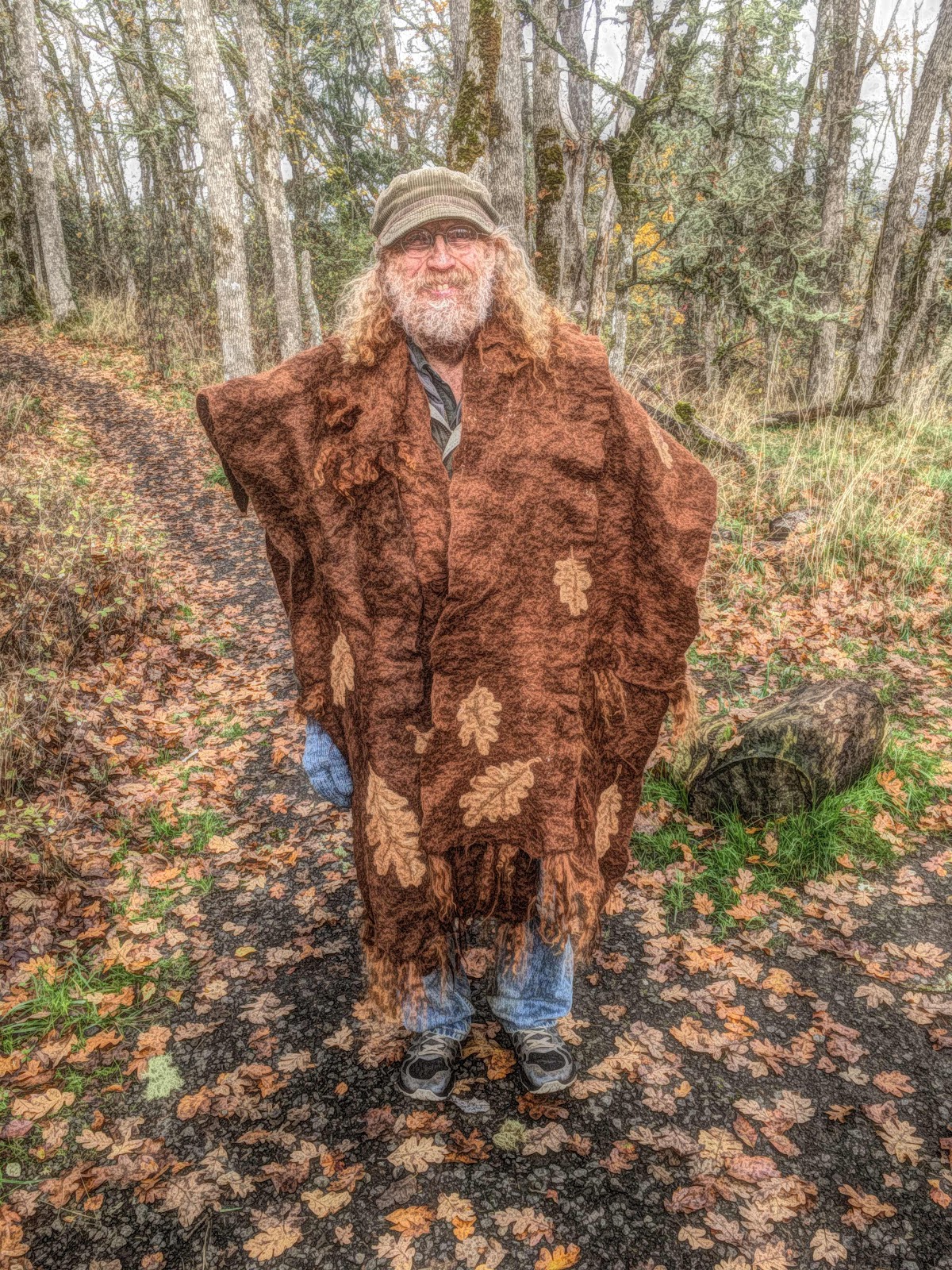
Then the oak leaves speak to me. I gather a few different sizes and bring them home, tracing around them to needle felt each one to the poncho.


The result is a surprisingly lightweight but cozy poncho. 


Monday, October 11, 2021

Free Stuff

Free Stuff


I like free stuff. I like the idea of free stuff, anyway. Most everyone responds to an offer of free, or they are at least willing to take a look. Probably the most eye catching word in advertising is “free”.


After a while too much stuff of any sort gets to be too much stuff, however, then you need space. Space for your stuff. Then you can set your stuff free, and someone else maybe will get some free stuff from you. I like the idea of the free box, Buy Nothing Day, and groups that circulate stuff to help people to share stuff they no longer want. 


There is something compelling and deep about getting free stuff. The free breakfast picked on your morning walk of blackberries that grow by the path. The free taste sample at the food booth. That chair left out by the side of the road that is just right for the kitchen table if you just tighten a screw. (Maybe I can paint flowers all over it. If I don’t like how it comes out, I can just give it away.)


I even love the beauty of the colorful leaf in the fall that I find on the ground, or that pebble or stone. A shaman would say if you impulsively pick up that particular rock you find on your path, it is, for you, a power rock. 


Today’s haul of free stuff from my morning walk includes a special, beautiful acorn. Perhaps it will sit in my house, being beautiful, for a while, then maybe I will plant it somewhere. There are a few little oak trees around here that I probably planted; they have sprung up with no oak trees nearby. 


There is also a little eye I picked up, the clear plastic kind with a black disk that rolls around when you shake it. It is dented from having been stepped on. Probably fell off of some toy. There is another eye like that on the dashboard of my car now as well. They remind me to keep my eyes on the road. 


Many artists have been inspired by free stuff, even trash. There is a challenge in trying to turn ugliness into beauty; colorful bits of plastic are ugly by the roadside; but assembled into art, say, a plastic rainbow, they have a new incarnation. Some people do find this beautiful. 


But there is a dark side. At the risk of sounding an old cliche, there is no free stuff. Chasing after free stuff is self destructive and wasteful of our time, energy, our planet, and each other.


Maybe plastic garbage art is a way of raising awareness about all the stuff we throw away, like that plastic; it never really goes away. Indeed, art can be sad, poignant. Or maybe it is a tacky way to justify all this disposable stuff we make. I know some people want art made from the finest wood, or precious gems from deep in the earth, or made of pure gold. This is considered good taste. But is it? Maybe this sort of art is tackiest of all, since it makes the world uglier with deforestation and gratuitous mining.


We have, as a species, been loving free stuff for a very long time. At this point, we have efficiently harvested most of the resources of the planet, imperiling ourselves, most other creatures and life forms, and the future of our civilization. Something is wrong. Maybe all this stuff we have been enthusiastically helping ourselves to, is not so free after all. Our hunting and gathering instinct has gone awry. 


I see this attitude twisting people in personal weird directions too. Compulsive shoppers sit amid piles of unopened packages previously ordered, while they shop, order, hunt and gather more. Hoarders stuff their houses with, well, what anyone else can see, is trash. Sweet loving people stuff their bellies with food that is bad for them, simply because it is free, or so cheaply made or sourced, that it is almost free. Then, when they inevitably get sick from such self abuse, they swallow toxic so called medicine, simply because it is what their medical so called “plan” pays for. It is “free”: There is no co-pay. Or is there?  Soon they are freed of their body!


Contorting ourselves in ways we would not choose if we were to really think about what we actually want, we compulsively obey the rule to always go for the free stuff, or the cheapest stuff, erroneously assuming that in so doing, we are saving up some virtual bank account of abundance in the future. But what if the exact opposite is the case? 


Buy Everything 


Maybe we could reframe the acquisition of stuff. Consider everything to be a purchase: we buy it with our precious time, energy, attention, and yes, our imaginary cultural creation, money. You may think you have insufficient stores of some of these; most people do think that, but that is another whole essay for another day. You do have some, now, at hand, at least. 


So what is the best way to spend these precious resources in your power here and now? What will you purchase with this day of time, this hour of energy, this moment of attention? And who is being fooled when you hunt down and buy karma laden toxic food and gather cheap crap? Is it really free, or borrowed from the health of all of us? Is it not stolen goods purchased from thieves?


All spending is actually giving. So it comes back to you multiplied. What is the karma you purchase with your gift? Is it a better world, or a debt of damage to repair?


The shaman would tell us that nothing is free, for every action carries karmic consequences. She would say we must ask permission for every flower picked, even to take the fallen leaf; and we also must give thanks for each and every thing we take. Even photographs.


We have taken abundance and turned it into scarcity: we have hunted and gathered, exploited and mined, burned and harvested our way toward oblivion and desolation, just by following our instinctive impulse to get some more free stuff. 


Why?! And what to do instead? First, we need to expand the definition of ourselves. If we hunt and gather only personally, for me and mine, we make bad decisions. What all is rolled into each purchase and acquisition? We need to consider the long term ramifications of each harvest, extraction, each taking from the commons we all share. And “we all” includes the other animals, and the wider whole fabric of the living web on the planet we share. Are we shredding and tearing this fabric, or mending it?


Is this product we are buying the very best choice, not only for the moment, say, this meal in this moment of appetite? Or does it cost a little more but helps build soil, relationships, a healthy body and sane mind, even steady state economies?


An infinitely expanding economy of the type humans have been living with most recently, requires continuous appropriation of raw materials and resources that are not free at all. They are, in fact, being stolen from us all, the commons, and the future health of our descendants and the world they will inherit. It is based on the philosophy of the cancer cell, uncontrolled proliferation, production and growth now, and nothing else. It is unsustainable and self destructive. 


A sustainable steady state economy still allows for infinite growth, but it is a healthy growth: making ever more time to learn, play, rest, meditate, create art and music, take care of each other, make love, evolve, expand our awareness and growing in compassion. Unlimited growth potential here. 


There is a lot of freedom in this, and maybe not as much emphasis on free stuff. Maybe free stuff is just a poor substitute for freedom itself. Personal freedom will be a casualty of all of this grabbing of unguarded resources, if we don’t change the way we think of economics.


Maybe the impulse to amass and consume free stuff is just a misguided quest for love and learning. Maybe, a way to heal the scarcity thinking that goes with overemphasis on amassing more stuff, is to collect wisdom, amass gratitude, produce more love.


We have, on average, on Earth, for now, the means to stay individually free and autonomous while additionally sharing enough wealth to keep everyone healthy and comfortable. We have enough knowledge to do this sustainability while repairing the environmental damage from before. We have ways and means enough. But do we have the wisdom and the will?